
The quick answer
Ready-made curtain panels are usually 38 to 54 inches wide, with 52 inches the most common in the catalog I counted. The usual lengths are 63, 84, 95 or 96, 108 and 120 inches. Sizes are written width first, then length. Buy by the rod, not the glass: measure the rod width and the rod-to-floor drop, then pick the panel count and length from the tables below.
Most curtain returns come down to two numbers that were never measured: how far the rod sits from the floor and how wide it is. A panel that stops three inches short looks like a mistake, and one pair on a wide window looks thin even when it fits. This page lists the sizes makers sell and the fullness rules that decide how many panels you need.
Standard panel sizes
There's no legal standard, so "standard" means what stores stock. Hunker puts off-the-rack panel widths at 42 to 52 inches and lengths from 63 to 144 inches, with 84, 96 and 108 the most common. I counted the online curtain catalog of one maker, Lush Decor, on October 25, 2026: 190 products with 1,295 size and color options at 60 inches long or more. Of those options, 620 were 52 inches wide, 178 were 54, 175 were 38, 148 were 40 and 103 were 42. Eclipse sells its Fresno blackout panel in 52 by 63, 52 by 84, 52 by 95 and 52 by 108, according to a Sleepopolis review.
| Length | Share of Lush Decor options | Where it usually works (my reading) |
|---|---|---|
| 63 in | 13% | Rod just above a window; curtain ends at the sill or apron |
| 84 in | 53% | Floor length when the rod is about 7 feet from the floor |
| 95 or 96 in | 22% | Rod mounted higher; usual match for 9-foot ceilings |
| 108 in | 9% | Tall ceilings, or extra length for a puddle (Hunker) |
| 120 in | 2% | Very high rods or ceiling-height runs |
The percentages are my count of that one catalog, so read them as a pattern in what a major maker lists, not a national figure. The last column is judgment based on the rod-to-floor rules below.
Makers disagree on 95 versus 96. Lush Decor and Eclipse use 95, while Hunker and The Shade Store list 96. One inch rarely matters for a pooled hem and sometimes matters for one that floats just above the floor, so check the number on the package.
How many panels you need
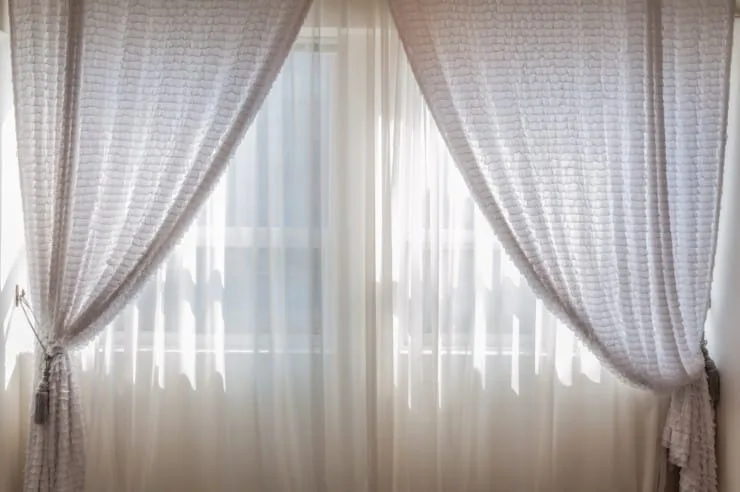
Curtains hang gathered, so the fabric has to be wider than the rod. The Shade Store says to multiply the width you're covering by 1.5 to 2, and by 2.5 to 3 for sheers. Hunker says the total should be at least double the window width. IKEA's guide gives 1.5 to 2 times as well. Blinds.com uses a flat method for outside mounts instead: window width plus 6 inches on each side, divided by the number of panels.
The table assumes 52-inch panels and the 1.5 to 2 times rule, using the rod width without finials. The arithmetic is mine.
| Rod width | Total fabric needed | Panels of 52 in |
|---|---|---|
| 36 in | 54 to 72 in | 2 (104 in) |
| 48 in | 72 to 96 in | 2 (104 in) |
| 60 in | 90 to 120 in | 2 is tight at 1.7x; 3 gives 156 in |
| 72 in | 108 to 144 in | 3 (156 in) |
| 100 in | 150 to 200 in | 3 is minimum (156 in); 4 gives 208 in |
| 120 in | 180 to 240 in | 4 (208 in) |
If you buy panels in narrower widths like 38 or 40 inches, you need more of them. The 100-inch row answers the old question about a 100-inch window: it takes three to four 52-inch panels, not two.
Measure from the rod
- Rod width. Measure the rod itself, not including finials. Finials add roughly 1 to 7 inches per side, according to Blinds.com.
- Rod placement. For an outside mount, The Shade Store says the rod typically extends 6 to 12 inches past the frame. Blinds.com says to mount it 6 inches above the window if space allows.
- Drop. Measure from the rod bracket (where the curtain will hang) down to the floor. Use that figure to choose the length.
Length styles
The length you order is the drop, plus or minus the style adjustment. The two sources I checked disagree on the puddle numbers, so I've shown both.
| Style | Order length vs. rod-to-floor drop | Notes |
|---|---|---|
| Sill or apron | To the sill, or about 1 in below it | Café curtains are the shortest style (Hunker) |
| Float | Drop minus 1/4 to 1/2 in | Blinds.com's floor length is 3/8 in above the floor |
| Break | Float length plus 1 to 2 in | Touches the floor lightly |
| Puddle | Float plus 3 to 6 in (The Shade Store); drop plus 6 to 12 in (Blinds.com) | Blinds.com says stationary panels only |
Blinds.com recommends the floor-length float for panels you open and close often. My guess at the reason is that fabric resting on the floor drags and gets dirty.
When your drop falls between sizes
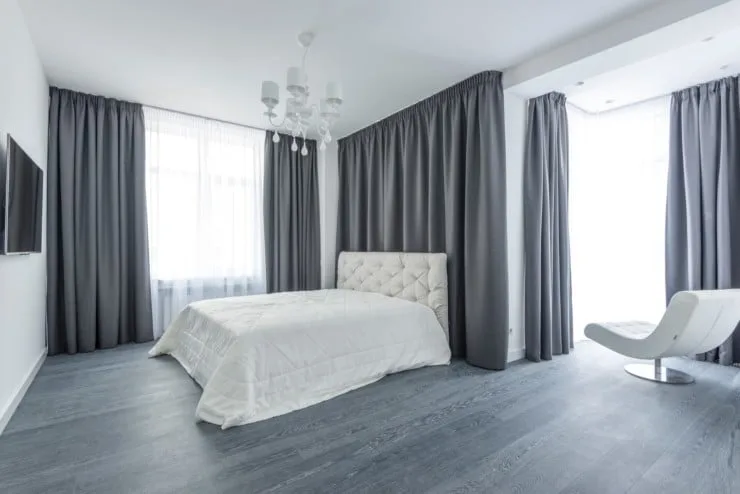
Say your rod sits 90 inches from the floor. No 90 exists, so a 95 or 96 panel would break or puddle by a few inches, and an 84 would leave a visible gap. In my judgment, the longer panel looks better if you're happy to have it brush the floor, and the shorter one is only right for a deliberate apron look. Moving the rod up or down a few inches to match a stocked length is often cheaper than hemming. Custom or hemmed panels fix an odd drop but cost more and take longer.
For a closet opening, the same width rule applies. See how to cover a closet without doors for a curtain-on-tension-rod setup.
Frequently asked questions
What are the standard curtain panel sizes?
There's no official standard. Retail panels are mostly 38 to 54 inches wide, and 52 inches is the most common width in the catalog I counted. Common lengths are 63, 84, 95 or 96, 108 and 120 inches.
How wide should curtains be for a 100-inch window?
Plan for 150 to 200 inches of total fabric, using the 1.5 to 2 times rule. With 52-inch panels, that means three at the minimum and four for a fuller look.
Should curtains hang to the floor?
They don't have to. Sill and apron lengths are normal styles, especially where furniture or a radiator is in the way. For a floor-length look, Blinds.com recommends a float just above the floor on panels you open and close often.
Are 95-inch and 96-inch curtains the same?
Almost. Makers label the same class of length differently: Lush Decor and Eclipse use 95 and The Shade Store and Hunker use 96. Check the exact number on the package if the hem needs to hit a precise height.
Sources
- Lush Decor: Curtains collection (maker's panel sizes; counts are my tally of its product data)
- Sleepopolis: Eclipse Fresno blackout curtains review (52 by 63, 84, 95 and 108 inch panels)
- Hunker: What are standard drapery sizes? (widths, lengths, named styles, double-width rule)
- The Shade Store: How to measure for curtains (fullness, rod placement, float, break and puddle numbers)
- Blinds.com: How to measure draperies (6 inches per side, fullness, hem styles, finials)
- IKEA Indonesia: How to measure curtains correctly (1.5 to 2 times width, drape allowance, inside and outside mount)