
The quick answer
Yes, on the products Rust-Oleum lists for wood. Rust-Oleum's Universal spray lists wood as a surface, and its Stops Rust enamel sprays are described as ideal for metal and wood. Both are solvent-based aerosols that give off flammable, harmful vapor, so spray outdoors or in an open garage. Never sand or scrape old paint without checking for lead first. Use a primer on bare wood with Stops Rust, since the maker recommends one.
Rust-Oleum has a reputation as a metal paint, so people ask whether it will hold on a chair, a shelf or a set of shutters. The sheets say it will. The bigger question is where you spray it, because the can labels carry some of the strongest warnings on any paint a homeowner buys.
The details below come from Rust-Oleum's own product pages, technical data sheets and a can label. They cover Universal and Stops Rust. Other Rust-Oleum lines have their own sheets.
Safety First: Fumes, Fire and Lead
The Universal can label starts with "Danger! Extremely flammable liquid and vapor." It adds that the vapor is harmful and may cause a flash fire, and that the contents are under pressure.
- Ventilation. The label says to prevent vapor build-up by opening all windows and doors for cross-ventilation, and to ensure fresh air entry during application and drying. The technical sheets say to use outdoors or in a well-ventilated area such as an open garage.
- Ignition sources. The label says to keep away from heat, sparks and flame, not to smoke, and to put out all flames and pilot lights and turn off stoves, heaters and electric motors during use and until all vapors are gone.
- Symptoms. The label says the vapor may cause dizziness, headache or nausea. If your eyes water or you get a headache or dizziness, it says to wear a properly fitted NIOSH-approved respirator or leave the area for fresh air.
- Storage. Don't store the can above 120°F (48°C), and keep it away from children.
Our judgment: a bedroom or a basement with a pilot-lit water heater isn't a spraying spot, even with a window cracked. Paint the piece outside and bring it in once the smell has faded. If a paint smell lingers in the house afterward, see the paint smell section.
Old paint and lead
Rust-Oleum's data sheets carry this warning: if you scrape, sand or remove old paint, you may release lead dust, and lead is toxic. The sheets say to wear a NIOSH-approved respirator and to clean up with a HEPA vacuum and a wet mop. They point to the National Lead Information Hotline at 1-800-424-LEAD.
The EPA says homes built before 1978 may have lead-based paint, and that paint in good shape is usually not a problem. If sanding is unavoidable, it says to wet the area first, sand the minimum needed and clean up thoroughly. It says not to remove lead-based paint yourself, and it doesn't recommend consumer test kits for consumer products. It also lists refinishing old furniture among the jobs that can expose you to lead.
A painted dresser from an older house deserves that caution. Bare, unpainted wood doesn't carry the lead risk.
Which Products Work on Wood
Rust-Oleum's Universal page says the spray is formulated for diverse surfaces including wood, plastic, metal, concrete and vinyl, and calls it a paint and primer in one. Its technical data sheet says the satin enamel sprays are suitable for metal, wood, plastic, wicker and aluminum.
The Stops Rust enamel sprays are described as ideal for ferrous and non-ferrous metal and wood surfaces, and not for galvanized metal. That sheet also says a Stops Rust primer is especially recommended for bare wood and metal. It lists a white and a gray bonding primer among its recommended primers.
| Universal spray | Stops Rust enamel spray | |
|---|---|---|
| Wood listed? | Yes | Yes |
| Primer | Sold as paint and primer in one | Primer recommended on bare wood |
| Hold the can | 8 to 12 inches | 10 to 16 inches |
| Dry to touch | 30 minutes | 2 to 4 hours |
| Handle | 1 hour | 5 to 9 hours |
| Fully dry | 24 hours | 24 hours |
| Recoat window | Within 1 hour or after 48 hours | Before 1 hour or after 48 hours |
| Coverage per 12 oz can | 10 to 15 sq ft | 6 to 10 sq ft |
Dry times are based on 70°F and 50% humidity, and the sheets say to allow more time when it's cooler. The coverage figures are Rust-Oleum's own, and they assume 15% material loss. Our judgment: a small table top can use most of a can.
Prep the Wood
- Wash off dirt, grease and oil with a commercial detergent, rinse with fresh water and let the wood dry completely. Both sheets say this.
- Remove loose paint with sandpaper or a wire brush. Rust-Oleum says previously coated surfaces must be sound and in good condition. Stop here if the old coat could contain lead.
- Sand smooth, hard or glossy finishes so the paint has a surface to grip. The sheets say to scarify them by sanding.
- Prime bare wood if you use Stops Rust. With Universal, the maker sells the product as paint and primer in one, so no separate primer is called for.
- Check the temperature. The sheets say to spray between 50 and 90°F with humidity below 65%.
Stained or varnished wood is a glossy finish, in our judgment, so it needs the sanding step. Rust-Oleum's sheets don't discuss stain by name.
Spraying and Drying
Shake the can for one minute after the mixing ball starts to rattle. If it doesn't rattle, Rust-Oleum says not to strike the can and to contact the company. Slide off the red safety clip before spraying.
Hold the can upright at the distance the sheet gives, spray in a steady back-and-forth motion and overlap each pass slightly. Keep the can moving at the same height. Apply two or more light coats a few minutes apart rather than one heavy coat. Heavy coats risk runs and sags, which the Stops Rust sheet mentions.
Mind the recoat window. Both sprays say to recoat within one hour or after 48 hours. If you miss it, wait. Cover the area around the piece to catch spray mist, and avoid windy, dusty days.
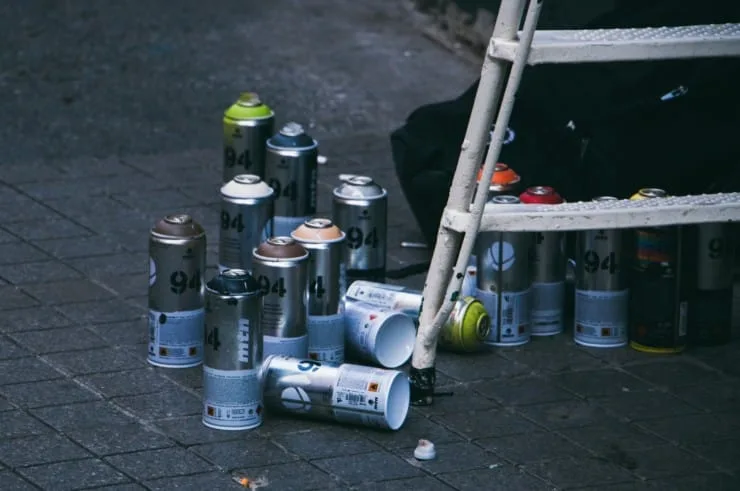
When you finish, wipe off the spray tip before storing the can. Clean wet paint with xylene or mineral spirits, and throw away the empty can in the trash pickup. Don't burn it or put it in a trash compactor.
Brush-On Enamel
Rust-Oleum's Stops Rust oil-based brush enamel data sheet describes use on steel and doesn't list wood. The Stops Rust Protective Enamel product page does say it gives superior coverage over metal, wood, ceramic and more. Those two statements don't line up, so confirm on the can before brushing it onto wood.
That sheet says to apply only between 50 and 90°F and below 85% humidity, to recoat after 24 hours, and to clean tools with mineral spirits. Its solvent is mineral spirits, so the same ventilation habits apply.
Frequently Asked Questions
Do I need to prime wood before using Rust-Oleum?
With Stops Rust, yes: the technical sheet says a Stops Rust primer is especially recommended for bare wood. Universal is sold as a paint and primer in one.
Can you use Rust-Oleum on stained wood?
Rust-Oleum's sheets don't address stain directly. They say previously coated surfaces must be sound, and that smooth, hard or glossy finishes should be sanded. Test a hidden spot before committing.
Does Rust-Oleum waterproof wood?
The sheets we read don't make that claim for wood. Universal is labeled for interior and exterior use, and Stops Rust is described as a rust-preventive enamel.
Is it safe to spray Rust-Oleum indoors?
The label says to use outdoors or in a well-ventilated area such as an open garage, and to keep flames and pilot lights off. Our judgment is to spray outside.
How long before I can use the painted piece?
Universal is dry to touch in 30 minutes, handleable in 1 hour and fully dry in 24 hours at 70°F and 50% humidity. Stops Rust enamel spray needs 2 to 4 hours to touch, 5 to 9 hours to handle and 24 hours to dry fully. Cooler or damper conditions take longer.
Sources
- Rust-Oleum: Universal Satin spray paint product page (wood listed, paint and primer in one, hold distance)
- Rust-Oleum: Universal Satin Enamel Sprays technical data (PDF) (surfaces, prep, ventilation, lead warning, dry and recoat times, coverage)
- Rust-Oleum: Universal spray can label (PDF) (flammability, ventilation, respirator and storage warnings)
- Rust-Oleum: Stops Rust Enamel Sprays technical data (PDF) (metal and wood, primer for bare wood, dry times, coverage)
- Rust-Oleum: Stops Rust Enamel Brush technical data (PDF) (brush enamel conditions and recoat)
- Rust-Oleum: Stops Rust Protective Enamel product page (coverage over metal, wood and ceramic)
- EPA: Protect your family from sources of lead (pre-1978 homes, sanding, test kits, refinishing furniture)
Check the label on your own can. Formulas and instructions vary by product line and can change.