
The quick answer
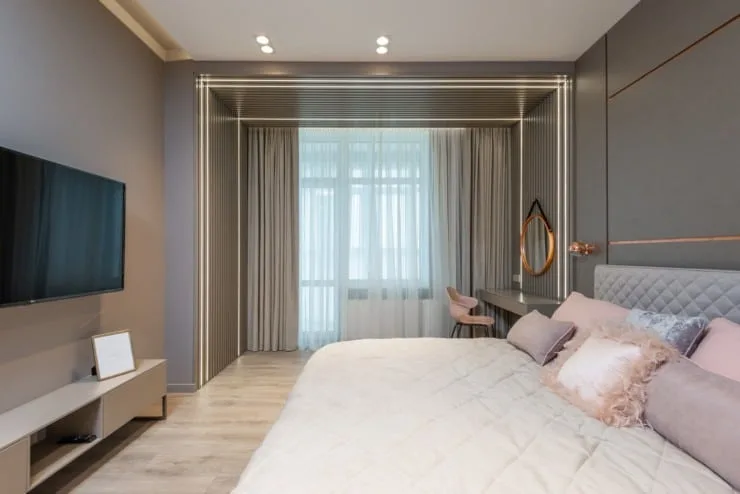
Samsung and Sanus both put the center of the screen about 42 inches off the floor, which matches a seated eye level. That's a sofa number. In a bedroom, mount lower than you'd guess if you watch sitting up against the headboard, and use a tilting mount if the screen has to sit high. Measure from your own pillow position before you drill.
A TV that's too high costs you nothing on day one and a stiff neck by week two. Holes in a wall are also hard to undo, so the height is worth five minutes with a tape measure.
Most published advice is written for living rooms. A bed changes the numbers, because your eyes are lower, you recline, and the headboard may push you back.
The 42-inch rule and where it stops working
Samsung's support page says to mount a TV 42 inches from the floor to the center of the screen, and to sit in your usual spot and have someone measure your eye height if you can. Sanus, a mount maker, gives the same figure and calls it the best viewing height, measured to the center of the screen. Both assume someone sitting upright on a couch.
Bedrooms break that in three ways. Mattress tops vary, so your eyes sit lower or higher than a sofa sitter's. Many people lie back against pillows. And a bedroom TV often sits on a dresser, which pushes the screen up. Any one of those moves the right height by several inches, and two together can move it by a foot.
Harvard Health warns that holding your head angled up or down for a long stretch strains the neck muscles because of the weight of the head. It also says to keep TVs at eye level, and notes that many people lean far back while watching, which stretches the neck backward. There's no standard that sets an exact bedroom height. Treat the numbers below as arithmetic and judgment, not a code.
Find your own height in four steps
- Get into your normal watching position in bed, propped on the pillows you actually use.
- Have someone measure from the floor to your eyes while you look straight ahead at the wall.
- Tape the outline of the TV on the wall with painter's tape. RTINGS suggests this trick to judge size and position before you commit.
- Go back to the bed and check the top edge of the tape without lifting your chin.
If the top edge makes you tip your head back, the tape is too high.
Lower it, or plan for a tilting mount. Use the center of the screen as your reference point, because that's where mount makers measure.
How much angle is too much
Distance matters as much as height. The farther you are, the smaller the upward angle for the same extra inches. The table below is my own geometry for a 55-inch TV, about 27 inches tall by RTINGS' size chart, viewed from 8 feet. It shows how far up you'd look to reach the center and the top edge for a given rise above your eyes.
| Screen center above your eyes | Angle up to the center | Angle up to the top edge |
|---|---|---|
| 0 inches (level) | 0 degrees | 8 degrees |
| 12 inches | 7 degrees | 15 degrees |
| 24 inches | 14 degrees | 21 degrees |
| 36 inches | 21 degrees | 27 degrees |
I'd call 12 inches above eye level a comfortable ceiling for a long film, and 24 inches the point where most people start to feel it. That's a judgment, not a measured limit. Watching lying down makes the upward angle feel steeper than the table says, because your neck is already bent against the pillow.
Posture matters as much as the mount. Consumer Reports quotes a physical therapist, Kevin Weaver, who says to position yourself so you don't have to twist your neck or back to see the screen, and to use extra pillows to support your back and neck. His advice was about laptops in bed, so applying it to a TV is my extension. A pillow stack is a cheaper fix than a second set of holes.
Height and distance by TV size
Bigger screens are taller, so the bottom edge drops if you hold the center at 42 inches. The screen heights and 30-degree distances come from RTINGS. The bottom-edge column is my subtraction, and it only applies if you choose a 42-inch center.
| TV size | Approx. screen height | Suggested distance (30 degrees) | Bottom edge if center is 42 in |
|---|---|---|---|
| 43 inch | 21.1 in | 5 ft 10 in | about 31 in |
| 50 inch | 24.5 in | 6 ft 9 in | about 30 in |
| 55 inch | 27 in | 7 ft 5 in | about 28 in |
| 65 inch | 31.9 in | 8 ft 10 in | about 26 in |
| 75 inch | 36.8 in | 10 ft 2 in | about 24 in |
RTINGS bases the distance on a screen filling about 30 degrees of your view. A quick check from its guide: divide your viewing distance in inches by 1.6 to get a rough TV size. Bedroom viewing distances are often shorter than living room ones, so a 43 to 55 inch set may be enough. Measure from your pillow to the wall before buying.

TVs above a dresser
Furniture under the screen forces the height up. Samsung says to leave about 4 to 6 inches between the furniture top and the bottom of the TV. Sanus uses a bedroom dresser or armoire as its example of a setup that pushes the TV higher, and says a tilting mount helps you reach the right viewing angle in that case.
If the dresser puts the center of a 55-inch set at 60 inches, and your eyes are at 36 inches in bed, you're at the 24-inch row of the table above. A tilt mount that angles the screen down toward you helps with picture visibility, but it doesn't remove the neck angle. The better fix is a lower or shorter piece of furniture, or moving the TV to the wall opposite your head.
Mounting it safely
- Attach the mount to a stud. Samsung says drywall anchors such as toggle bolts are an option only after you confirm the wall can carry the weight.
- Get a second person. Samsung's guide says not to mount the TV by yourself.
- Check your TV's manual for the mounting pattern and screw length before you buy a mount.
- For hidden cables, Samsung points to in-wall rated cables and a kit made for running them through the wall. An ordinary extension cord isn't what those kits replace, so don't push one inside the wall.
- In a child's room, a wall mount also keeps the set off a dresser top. CPSC recommends mounting flat-screen TVs to the wall or anchoring them, because tip-overs injure children every year. More on that in how to protect a TV screen from kids.
Frequently Asked Questions
Is 42 inches too low for a bedroom TV?
It can be. Samsung and Sanus give 42 inches to the screen center as the default for someone sitting upright. If you lie back against pillows, your eyes may be lower, so the same TV can feel too high in bed. Measure your own eye height in your normal pose.
Do I need a tilting mount for a bedroom TV?
If the center sits more than about a foot above your eyes, yes. Sanus recommends a tilting mount when furniture forces the TV higher. It improves the viewing angle, but it can't fix a screen that's far above your eye line.
How far should a 55-inch TV be from the bed?
RTINGS puts the 30-degree distance for a 55-inch TV at about 7 feet 5 inches. Sitting a little closer works for gaming, and a little farther is fine for casual viewing. It's a guide, not a rule.
Can I put a TV on a dresser instead of the wall?
You can, but CPSC advises anchoring TVs to the wall, and says to place them only on furniture made to hold one. A dresser isn't built for a TV. If you do use one, keep the set pushed back and anchored, and keep remotes and toys off the top.
Sources
- Samsung: Things to consider before mounting your TV to a wall (42 inches to center, 4 to 6 inches above furniture, studs, getting help, in-wall rated cables)
- SANUS: How high should I mount my TV? (42 inches to center, tilting mount with a dresser or armoire)
- Harvard Health: Surprising causes of neck pain (screens at eye level, strain from leaning back, changing position every 15 to 20 minutes)
- RTINGS: TV size to distance calculator (screen heights, 30-degree distances, painter's tape trick)
- Consumer Reports: How to correct your binge-watch posture (physical therapist advice on pillows and not bending the neck)
- CPSC: Anchor It! (mount or anchor flat-screen TVs, use furniture made for TVs)
The angle table, the bottom-edge column and the comfort thresholds are my own arithmetic and judgment, not published standards. Check your TV and mount manuals for exact specs.