

The quick answer
Foil can scare a mouse off a shelf or countertop for a few days, then it stops working. It won't keep mice out of a house, and mice chew through it, so don't use it to plug holes. Seal every gap wider than a pencil with steel wool or metal and set snap traps along the walls. That's what university pest programs recommend.
The foil trick is popular because it costs almost nothing and feels like action. The risk is false comfort. A few weeks of "it seems to be working" gives a mouse family time to settle in, and house mice breed fast. Mice carry diseases and trigger allergies, so the sooner the real fix goes in, the better.
What Foil Actually Does
The best evidence is pest-control opinion, not a controlled trial. No university trial of foil as a repellent turned up in this research. Rick Culbreth Jr., a pest control company president quoted by Tom's Guide, calls foil "by no means a reliable mouse control solution" and says it may give "a limited deterrent effect for a short time." His reasoning: mice are cautious about new surfaces, so loud crinkling can keep them off for a while. Then, in his words, "they'll eventually learn that the foil is harmless and ignore it."
That matches how mice behave with other scare devices. UC IPM, the University of California pest program, says mice "quickly become accustomed to regularly repeated sounds" and that there is little evidence any sound, magnetic or vibrating device drives out an established population.

Don't Plug Holes With Foil
This is where most foil advice goes wrong. The same pest expert says plainly: don't use foil to block holes or entry points, because mice can chew through it. UC IPM lists gnawable materials as ineffective for plugging holes, and thin foil falls in that group by any practical test. Packing a gap with foil gives the mouse a soft wall to chew and no reason to leave.
If you use foil at all, lay it loose so it crinkles. Shelves, drawer bottoms, countertops and the gaps between appliances are the spots the expert suggests. Treat it as a few days of help while you do the real work, not a plan.
What Works Instead
Seal the gaps
CDC says a mouse fits through a hole the width of a pencil, about 1/4 inch. Walk the house and look at where pipes enter under sinks, around the dryer vent, along the foundation and at the garage door seal.
For small holes, CDC says to pack in steel wool and hold it with caulk. For larger ones it lists lath screen, hardware cloth, sheet metal or cement. UC IPM adds that steel wool works as a temporary plug but can rust over time, and that plastic, rubber, vinyl, wood and expanding foam don't stop mice. That last point matters because spray foam alone is a common mistake. Foam is only the retainer for the steel wool, never the barrier.
Trap before you seal
Seal-up works best after the mice inside are gone. One pest source warned that closing the only exit on mice still indoors can send them chewing elsewhere. That's one source, so treat it as a sensible precaution and not a measured result. Trap first, then seal.
UC IPM's snap trap advice is specific:
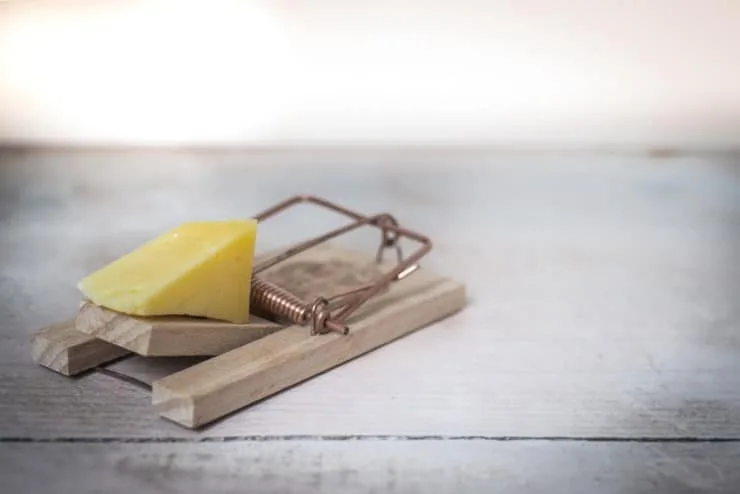
- Set traps behind objects and in dark corners, against the wall so a mouse runs across the trigger.
- Space them no more than about 10 feet apart where activity shows. Mice seldom travel more than 30 feet from their nest and food.
- Try pairs 1 to 2 inches apart, since mice sometimes jump over a single trap.
- Use a very small dab of bait and set the trigger lightly.
- Use food the mice already eat, or nesting material such as cotton wool or dental floss.
UC IPM notes peanut butter is popular but can be an allergy risk in a home with someone allergic.
Take away food, water and shelter
CDC lists food, water and shelter as what draws rodents in. Store pantry food in sealed containers, fix drips, and clear the cardboard boxes and clutter where a nest could hide. UC IPM is blunt that sanitation "will seldom completely control house mice" on its own, but removing nesting spots limits how many can live there.
Essential oils and scents show up in a lot of mouse advice. The extension pages cited here don't list them as a control method, so I wouldn't count on them.
Health and Cleanup
UC IPM lists leptospirosis, salmonella and lymphocytic choriomeningitis (LCM) among the diseases house mice can carry, and estimates about 5 percent of US house mice can pass on LCM virus. CDC adds that a rodent's appearance can't tell you whether it's carrying anything.
Don't sweep or vacuum droppings, nests or urine. CDC says that can put virus particles in the air. Its method:
- Put on rubber or plastic gloves.
- Spray the droppings until they're soaked with an EPA-registered disinfectant or a fresh bleach mix of 1 part bleach to 9 parts water (1.5 cups per gallon).
- Wait 5 minutes, or follow the label.
- Wipe up with paper towels and put them in a covered trash can.
- Mop or sponge the surface with disinfectant, then wash your hands with soap and warm water.
If mice have reached spaces you can't get to, such as inside walls, CDC suggests calling a pest control professional.
Frequently Asked Questions
Will mice eat through aluminum foil?
They can chew through it. A pest control expert quoted by Tom's Guide says mice can easily chew through foil and quickly learn it's harmless, so don't use it to block holes.
How long does foil keep mice away?
Not long. The same expert describes only a limited, short-term effect, and UC IPM says mice get used to repeated sounds. No published trial located measured how many days it lasts.
What is the best way to keep mice out of the house?
Seal every opening larger than 1/4 inch with steel wool, hardware cloth or sheet metal, trap any mice already inside, and remove food, water and nesting spots.
What won't mice chew through?
UC IPM recommends metal or concrete for sealing, and coarse steel wool or wire screen for small cracks. It says plastic screening, rubber, vinyl, wood and expanding foam are ineffective.
Sources
- Tom's Guide: Does aluminum foil keep mice away? (pest expert comments on foil, chewing and short-term effect)
- UC IPM: House Mouse (exclusion materials, 1/4 inch gaps, traps, sound devices, sanitation, disease)
- CDC: How to Seal Up to Prevent Rodents (pencil-width holes, steel wool and caulk, hardware cloth)
- CDC: How to Clean Up After Rodents (cleanup steps, bleach mix, no sweeping or vacuuming)
- CDC: Rodent Control (food, water and shelter, diseases, signs)
The foil comments come from one pest control company's president as quoted in a news article, not from a published experiment.